
Toronto Metropolitan University
UniPath editorial interpretationDowntown at Yonge and Dundas, where most of the community commutes in.
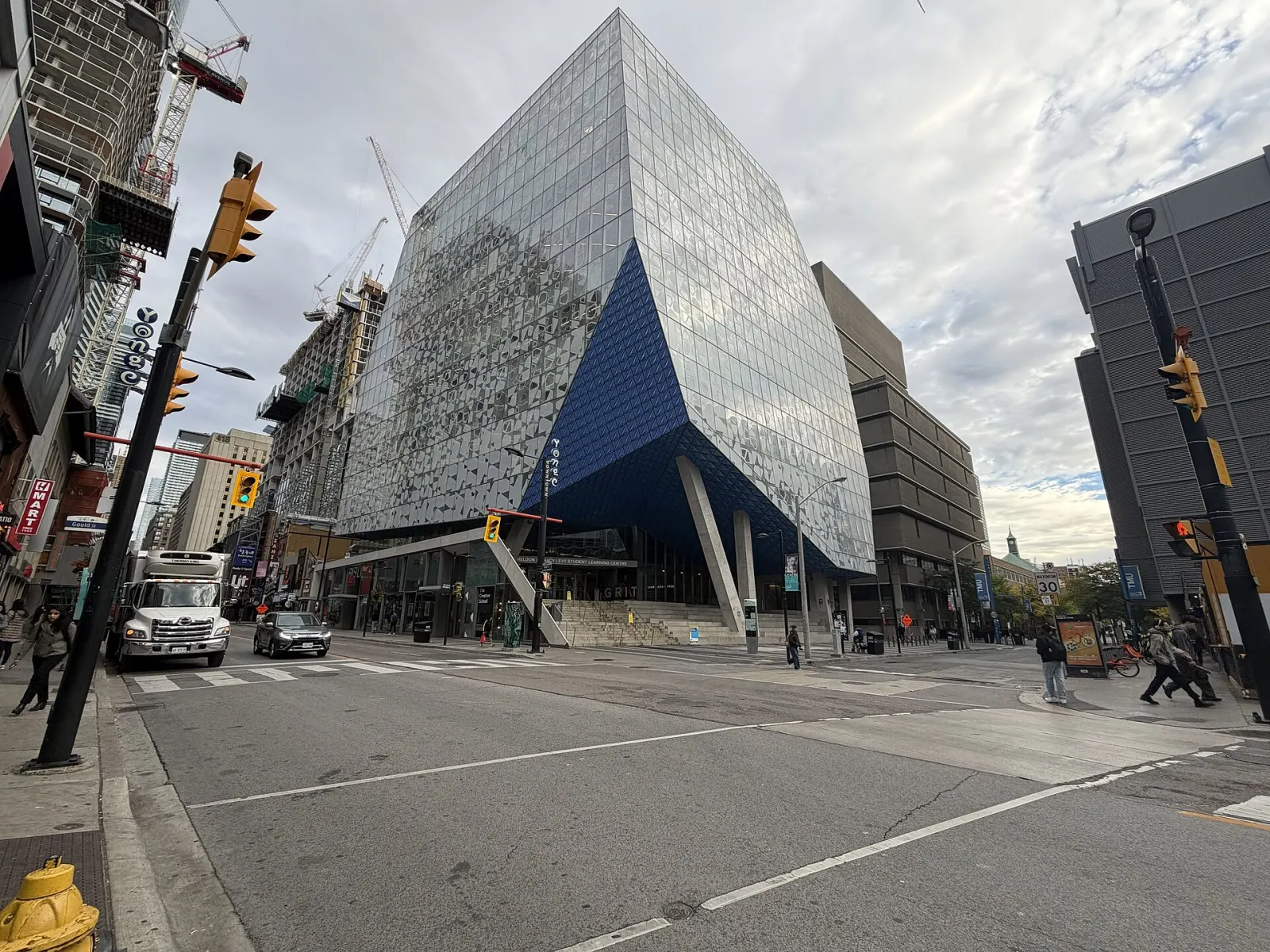
TMU's campus is at Yonge and Dundas in downtown Toronto, by the Line 1 subway station renamed TMU Station in December 2025. TMU says more than 80% of its 50,000 students, staff and faculty commute. At the heart of campus are green spaces including the Kerr Hall quad and Lake Devo. Toronto's average one-bedroom rent was $1,761/month in CMHC's October 2025 survey. Our read: urban, practical and energetic, with no campus bubble to retreat into.
Factual statements checked 12 Sep 2026. See the linked “What we checked” trail under the editorial ratings.
Daily life
What it’s actually like
The student experience at TMU
UniPath editorial interpretation · Sources reviewed June 2026On RateMyProfessors, TMU sits at 3.7/5 across 890 ratings (the largest sample in this group). Students rate the downtown location highly (4.4) and value its practical, industry-connected programs, but safety is by far the weakest category (2.8), with repeated comments about the area immediately around campus.
UniPath editorial interpretation
Not a survey or official factOur read: hands-on, career-oriented programs that are demanding but practical rather than cut-throat; intensity varies by program.
Our read: diverse and approachable, but with more than 80% of the TMU community commuting in, building your circle takes deliberate effort.
Our read: downtown Toronto is right there, so nightlife and events are endless if you go looking for them.
TMU Station on Line 1 is at Yonge and Dundas, by campus. Central for transit, though with more than 80% of the community commuting, how easy it feels depends on where you live.
Our read: with most of the community commuting, traditional school spirit is limited, despite a growing identity.
Editorial ratings · facts checked against 5 sources, 12 Sep 2026
What we checked
Scores, “Our read” statements, the tagline and the best-for / not-for lines are UniPath editorial judgments — not survey results or official facts. Other factual statements are checked against the linked sources below.
Covers: TMU's downtown Toronto campus.
Specific to this campus
- The Kerr Hall quad and Lake Devo are outdoor spaces at the heart of campus. — TMU — Outdoor bookable spaces (checked 12 Sep 2026)
Living in residence
- TMU does not publish a formal first-year residence guarantee — available spaces are offered to first-year applicants on a priority basis, but when applications exceed capacity a waitlist is created. Apply as early as possible. — TMU Housing: applying (via UniPath residence data) (checked Jun 2026)
Commuting & getting around
- Dundas station was officially renamed TMU Station on December 7, 2025; it is on Line 1 Yonge–University. — TTC — Dundas and Eglinton West stations renamed as of December 7 (2025) (checked 12 Sep 2026) · TMU News — TMU Station is now official (Dec 2025) (checked 12 Sep 2026)
- More than 80% of TMU's 50,000 students, staff and faculty arrive daily as commuters. — TMU News — TMU Station is now official (Dec 2025) (checked 12 Sep 2026)
City & cost of living
- Average 1-bedroom purpose-built rent in Toronto: $1,761/month (CMHC, October 2025). — CMHC Rental Market Survey, October 2025 (via UniPath residence data) (checked Jun 2026)
A normal week
UniPath editorial interpretation · Sources reviewed June 2026Day-to-day here
Fully urban, integrated-into-downtown campus — commuting and city amenities are central to daily life.
Be aware of the surrounding-area safety concerns students raise most often.
Strong for creative/business/engineering career paths and internships.
Expect large intro classes and to book support services ahead during busy periods.
Campus map
The TMU campus
33 buildings on Toronto Metropolitan University's campus in Toronto, coloured by what they are. Pan and zoom to get a feel for the layout — how far the residences sit from the lecture halls, and where the libraries and athletics facilities are.
Building footprints and names come from OpenStreetMap contributors (ODbL). Coverage depends on what volunteers have mapped, so some buildings may be missing, renamed, or categorised imperfectly — this is an orientation aid, not an official campus map. Check TMU's own site for the authoritative version. See credits & sources.
What you may like
Straight talk
UniPath editorial interpretationOften praised
Prime downtown location with malls, restaurants and amenities all around campus (location 4.4, the top category).
Good fit for creative, business and career-oriented programs with strong industry ties.
Solid connectivity and opportunities (internet 4.1, opportunities 3.9).
UniPath editorial interpretation of recurring themes in public review platforms and surveys; not submitted here. RateMyProfessors — Toronto Metropolitan University (3.7/5, 890 ratings), TMU — Student Enrolment Overview (official), TMU — Tuition and Fees (official), Times Higher Education — World University Rankings 2026 · Sources reviewed June 2026.
UniPath editorial fit note: Best for: Practical, city-loving students who want hands-on programs and a downtown-Toronto lifestyle.
What may frustrate you
Straight talk
UniPath editorial interpretationWorth knowing
Safety is the lowest-rated category (2.8) — students cite the surrounding area.
Mixed academic experience; large first-year classes.
Campus feels less traditional than a self-contained campus.
UniPath editorial interpretation of recurring themes in public review platforms and surveys; not submitted here. RateMyProfessors — Toronto Metropolitan University (3.7/5, 890 ratings), TMU — Student Enrolment Overview (official), TMU — Tuition and Fees (official), Times Higher Education — World University Rankings 2026 · Sources reviewed June 2026.
UniPath editorial fit note: Not for everyone: Students craving a leafy campus, strong sports culture, or a tight residential community.
Residence versus commuting
Living in residence
- TMU does not publish a formal first-year residence guarantee — available spaces are offered to first-year applicants on a priority basis, but when applications exceed capacity a waitlist is created. Apply as early as possible. — TMU Housing: applying (via UniPath residence data) (checked Jun 2026)
Residence halls, costs and meal plans for TMU are listed on UniPath’s Residence page, checked against official housing pages (June 2026). See TMU residences →
Commuting & getting around
Getting around: Easy · 5/5
TMU Station on Line 1 is at Yonge and Dundas, by campus. Central for transit, though with more than 80% of the community commuting, how easy it feels depends on where you live.
- Dundas station was officially renamed TMU Station on December 7, 2025; it is on Line 1 Yonge–University. — TTC — Dundas and Eglinton West stations renamed as of December 7 (2025) (checked 12 Sep 2026) · TMU News — TMU Station is now official (Dec 2025) (checked 12 Sep 2026)
- More than 80% of TMU's 50,000 students, staff and faculty arrive daily as commuters. — TMU News — TMU Station is now official (Dec 2025) (checked 12 Sep 2026)
Academic information
Facts from named sources
Sourced fact · Sources reviewed June 2026TMU by the numbers
Standout undergraduate programs — UniPath editorial pick
This is UniPath's own editorial shortlist of programs TMU is known for, not an official ranking or an exhaustive list, and it has not been independently verified against the university's official program pages. See the Programs page for the full catalog and confirm specifics on TMU's official site before deciding. See credits & sources.
Overview
Downtown Toronto urban campus (formerly Ryerson). Media, business, and applied programs are the strengths; the Image Arts (film/photo) and Ted Rogers School of Management are nationally known.
Students here usually do best when they want a clear mix of academics, campus life, and future options after graduation.
TMU is especially useful for students comparing Engineering & Technology, Health Sciences & Medicine, Business & Commerce, and Arts, Design & Media in one place.
If you are trying to choose without living on official pages, the key thing to know is that TMU is less about one perfect brochure line and more about the day-to-day fit: workload, city, support, and where the degree can actually lead.
This page should give you the decision lens first, then the official site can be used later for final verification only.
Quick facts
Class size, cost of living, and the extracurriculars rating are UniPath editorial estimates, not official statistics. Tuition is an approximate base-program figure — your faculty and year may differ. The application deadline shown is the general equal-consideration date for direct-from-high-school applicants — many programs (Engineering, Business, Health Sciences, Nursing, etc.) and applicant types have their own different deadline. Confirm everything on the official site before you decide.
Verify on official siteHow to judge this university
Decision guide
Best for students who want a mix of strong academics and a campus with momentum.
Strongest academic lanes shown on UniPath: Engineering & Technology, Health Sciences & Medicine, Business & Commerce, and Arts, Design & Media.
Hardest part of choosing TMU: deciding whether the location, intensity, and culture actually match how you like to work.
Reality check
What students should be honest about
Do not choose TMU only because the name sounds strong. Make sure the exact program, campus feel, and lifestyle fit are also right.
If you want a lighter, more guided, or more intimate experience, compare that honestly against what TMU is usually known for.
Use the official site later to verify deadlines and exact program structures, but you should already know by then whether the school itself feels like your kind of place.
Programs at a glance
Where this university is strongest on UniPath
Engineering & Technology: Computer Science / Engineering
UniPath editorial estimate (school's overall average) — this program may differ: Engineering ranges move by discipline; software, computer, and biomedical routes are usually the most competitive.
Health Sciences & Medicine: Nursing / Midwifery / Nutrition
UniPath editorial estimate (school's overall average) — this program may differ: Health science, nursing, and pre-med-style routes often add supplementary review or clinical prerequisites.
Business & Commerce: Ted Rogers School of Management
UniPath editorial estimate (school's overall average) — this program may differ: Business programs may add supplementary applications, interviews, or leadership review.
Arts, Design & Media: RTA Media, Film, Graphic Communications
UniPath editorial estimate (school's overall average) — this program may differ: Creative programs may weigh portfolio quality more heavily than the grade range.
Sciences: Sciences
UniPath editorial estimate (school's overall average) — this program may differ: Science ranges vary heavily by major; data science, life sciences, and neuroscience trend higher.
Social Sciences & Law: Journalism / Social Sciences
UniPath editorial estimate (school's overall average) — this program may differ: Social science and law-pathway ranges vary by campus and may be writing-heavy after admission.
Computer Science & IT: Computer Science specializations
UniPath editorial estimate (school's overall average) — this program may differ: Computer science and software routes usually sit above the general university average.
Environment & Sustainability: Urban Planning / Environmental Programs
UniPath editorial estimate (school's overall average) — this program may differ: Environmental routes range from broad science entry to more selective sustainability or planning programs.
Frequently asked questions
Common questions about TMU
What is the admission average for Toronto Metropolitan University?
UniPath's editorial estimate for Toronto Metropolitan University's overall admission average is around High 70s to mid 80s. This is not an official cutoff — it's a planning estimate for the school as a whole, and the real number depends heavily on the program. Competitive programs (engineering, computer science, life sciences, business) usually need higher grades than this estimate. See our program pages for sourced, program-specific admission ranges.
What programs does Toronto Metropolitan University offer?
Toronto Metropolitan University offers programs in Engineering & Technology, Health Sciences & Medicine, Business & Commerce, Arts, Design & Media. Most students apply directly to a specific faculty or program rather than a general "arts and science" stream, so program choice matters as much as picking the school.
Where is Toronto Metropolitan University located?
Toronto Metropolitan University is located in Toronto, ON, Ontario. Location matters more than students expect: commute time, cost of living, climate, and the local job market all shape your day-to-day experience.
Is Toronto Metropolitan University a good university?
Toronto Metropolitan University is a recognized Canadian university with established programs and a track record of graduate outcomes. "Good" depends on fit: program strength in your area, campus culture, support systems, and post-graduation pathways matter more than overall rank.
How do I apply to Toronto Metropolitan University?
For Ontario residents, applications go through OUAC. For other provinces, you apply directly through the Toronto Metropolitan University website. Plan your timeline: most application deadlines fall between mid-January and early February for September entry, with supplementary materials due shortly after.